Dilusha Gonagala Software engineer Writer

Good software.
A little soul.

I’ve been making computers do things since 2004, when my first one ran Windows 95 on around 64 MB of RAM. Professionally since 2012. This site is the long exposure: what I’ve built, what I’ve written, and 2,121 thoughts I keep coming back to.

Engineering since 2012

How to read the sky: one ring per year

  1. First computer2004
  2. PowerPoint calculator2006
  3. Software, professionally2012
  4. Now2026
A note to myself{dilusha}
2,121 thoughts to wander through
An illustration from my original corner of the web: someone on a grassy hill with a laptop, looking out at a distant city.

The observer

It started with a calculator.
In PowerPoint. Seriously.

That feeling of wanting something to work never really left. This site is where I think out loud about the work, along with books, kindness, family, curiosity, and the life happening around it.

A little more about me
  1. 2004

    A first computer.

    Windows 95, around 64 MB of RAM, and 22 years of wanting to know how things work.

  2. c. 2006

    A calculator, in PowerPoint.

    Around 17 hours and roughly 2,000 linked slides. I didn’t know what programming was yet. I only knew I wanted it to work.

    How I fell in love with code
  3. 2012

    Software, professionally.

    14 years since, across manufacturing, e-commerce, financial systems, and native apps.

  4. 2013

    Sublime Text and curiosity.

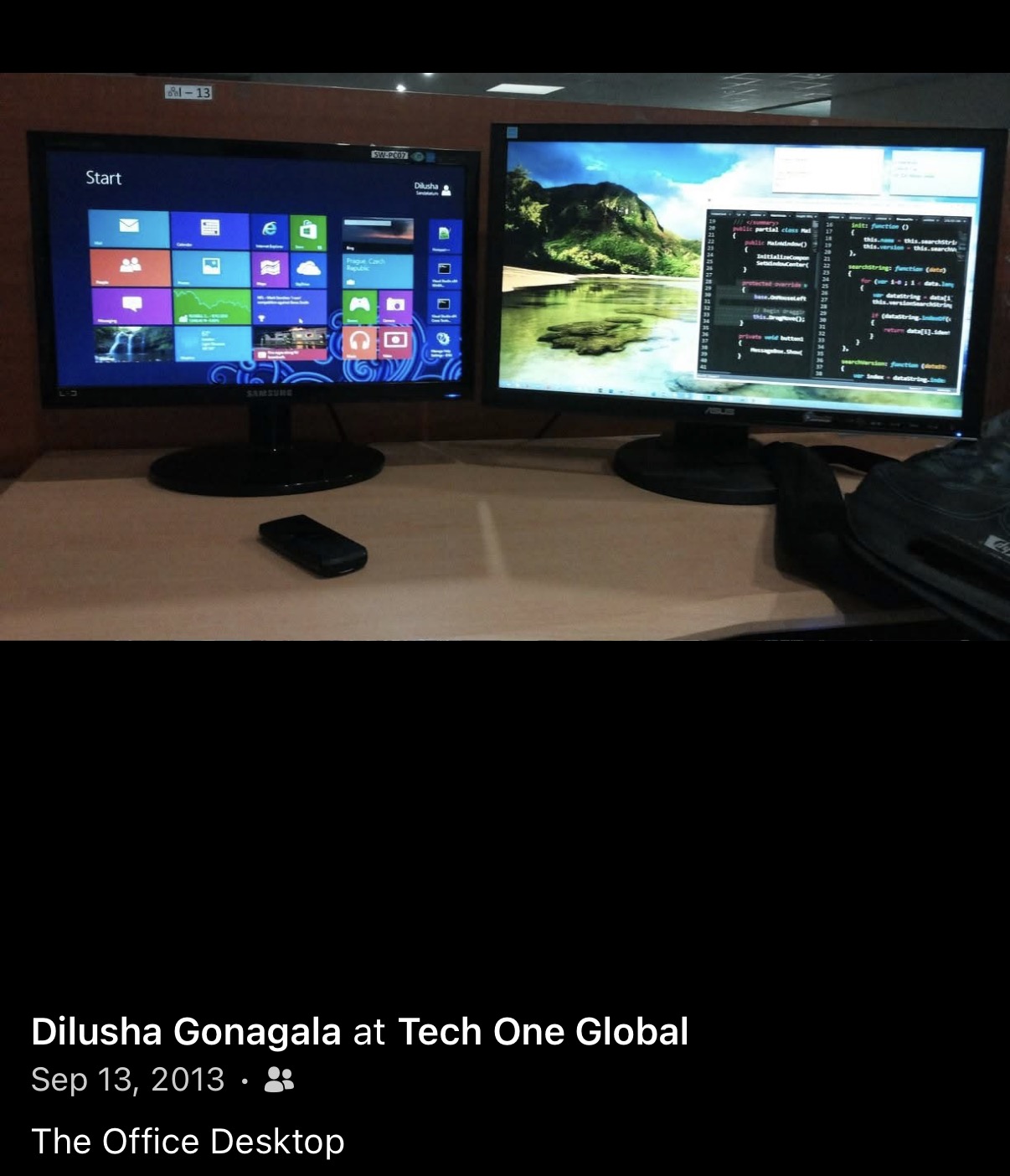
    A desk at my first job as an Associate Software Engineer. No AI, no shortcuts.

    A reminder from 2013
  5. Now

    Principal Software Engineer.

    Still building, still writing, and still curious enough to lose track of time making something work.

Star chart

Follow a
thread.

Software I’ve built, unlikely beginnings, and questions I haven’t finished asking. Pick a point and wander.

From the notebook / Where it began

Windows 95. Around 64 MB of RAM.

My first computer, in 2004. That’s where my engineering journey began.

By around 2006, I was making a calculator out of roughly 2,000 PowerPoint slides, before I understood what programming was. Seventeen hours later, it worked.

Engineering range

Different kinds
of building.

I move between the system and the screen. The tools depend on the work.

Platforms & infrastructure

The foundations that keep a product running.

AWS infrastructure, repeatable environments, deployment pipelines, and production troubleshooting. I use Terraform and CI/CD for web systems and native release paths.

Backend systems

The work behind the interface.

Node.js, TypeScript, and NestJS. APIs, payments, background jobs, data access, and performance work. This includes financial processing where deadlines and system limits are part of the design.

Web & native applications

The part people use.

React, Angular, and Astro on the web. Swift and SwiftUI on macOS. React Native and Expo on iPhone.

AI experiments

Build it, then question it.

Model integrations, output checks, and evaluation of generated text. I also experiment with Python, LoRA, and QLoRA. These are experiments, not claims that the hard parts have been solved.

Experience

The work
underneath.

Five systems. Five different things that could not be hand-waved.

Financial systems / Reliability

A processing window that could not keep slipping.

Statement processing began a few hours after the billing cycle opened. That left roughly three to four hours for each batch to finish.

What I worked through

Slow queries and hard system limits were eating into that window. I worked with the team to find the bottlenecks, improve the existing processing path, and rewrite the parts where smaller changes were no longer enough.

The decision was not simply whether to optimize or rewrite. It was deciding which parts justified each approach while still working inside limits we could not remove.

Company details, volumes, and implementation specifics stay private.

AgentsEye / Integration & reliability

An alert is only useful if you can trust it.

AgentsEye works across the major AI coding providers. Each one represents usage limits, resets, and unavailable data differently.

What I worked through

I built the logic that distinguishes fresh, stale, and unavailable readings, tracks usage across reset cycles, and avoids repeating the same alert.

History stays local. Native widgets and signed updates make the app useful after the dashboard is closed.

See it

DeSlop / AI product quality

A smoother sentence can still be wrong.

DeSlop accepts drafts up to 20,000 characters. Model-backed cleaning stops at 12,000.

What I worked through

I worked on the checks around those rewrites: comparing the result with the source, protecting concrete details, and leaving the result editable.

Fluent output is not proof that the meaning survived.

See it

FastRight / Mobile & data continuity

An update should not erase someone’s progress.

FastRight is in private beta. Its timers need to survive app restarts, data-format changes, and releases without quietly changing someone’s history.

What I worked through

I used saved timestamps, versioned migrations, and shared app and widget state. Before a backup replaces existing progress, the app validates it and keeps a recovery copy.

It works without requiring an account.

Private beta.

The notebook

Recent
prints.

Some are about software. Some are about life. Some made more sense when I wrote them. The note in the sky holds 2,121 more.

Open the notebook

Reminder to My Present Self from 2013

In 2013 it was just me, Sublime Text, and curiosity. No AI, no shortcuts. Just grind. Looking back now, I see how every small step shaped the life I have today.

Scarcity Makes You Hustle

Scarcity teaches grit in ways abundance never will. Looking back, my best skills were forged when every click and every second online had a cost.

The Two Great Tragedies

George Bernard Shaw once wrote that there are two great tragedies in life: the first is not getting what you want, the second is getting it. He was right.

I also take on a small number of focused, part-time freelance projects. If you have something specific in mind, contact me.

Agent Dex

Dilusha’s corner of the terminal

A guide to my work and notebook.
My AI stand-in, not me replying live.